American Visionary Art Museum American Visionary Art Museum Exhibits
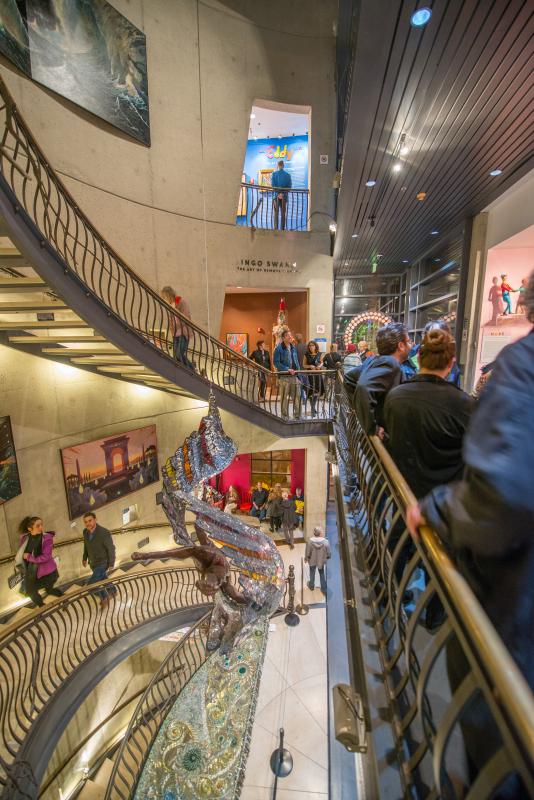
Within the American Visionary Art Museum. Photo by Shawn Levin
The American Visionary Art Museum (AVAM) is nestled like a glittering jewel in the Federal Hill neighborhood of Baltimore. In that location are no white walls and solemn security guards telling children to quiet down. The gift shop stocks applied jokes and novelty sunglasses. In the permanent drove, a bedazzled bed frame featuring Alfred E. Neuman sits directly across from the sculptural magnum opus of a terminally ill mental patient, which was carved from a unmarried piece of applewood. Neither piece of work seems out of place. Every bit the nation's premier museum for visionary fine art, AVAM has made information technology a central exercise to pair exuberance with teaching when contemplating and curating life's mysteries. In the process, it has elevated self-taught artists within the American canon, and showed only how much fun art museums tin can be.
Visionary art goes past many names: self-taught fine art, outsider art, and its original French counterpart, art brüt. AVAM defines visionary fine art equally work created by self-taught artists, whose "works arise from an innate personal vision that revels foremost in the artistic act itself."
The museum itself grew from the personal vision of founder Rebecca Hoffberger, who had no previous museum experience before she established AVAM. Hoffberger left her hometown of Baltimore at age 16 to study under acclaimed mime Marcel Marceau in Paris, founded her own ballet company by historic period 21, established field hospitals in Nigeria, and spent several years practicing traditional healing practices in rural Mexico (all while raising two daughters). By 1984, Hoffberger had moved back to Baltimore, where she was working as the development director of People Encouraging People, a nonprofit providing transformative mental wellness rehabilitation at Sinai Hospital.
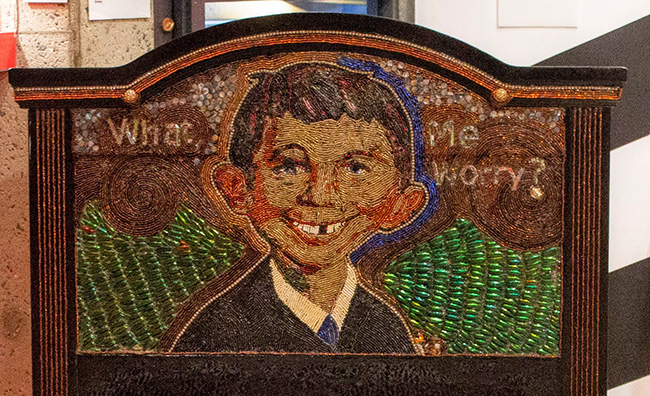
What Me Worry? Bed by Patty Kuzbida in Baltimore'due south American Visionary Art Museum. Photograph by Sophia Salganicoff
Hoffberger was intrigued past the intuitive creativity flowing from her patients, specially the art they created despite the lack of whatsoever formal training. "I'1000 very interested in where a fresh thought comes from," said Hoffberger.
At the time, there was still little interest surrounding self-taught artists in the United states of america, and only a dozen or and then visionary or outsider fine art spaces in existence worldwide. "For a long time before nosotros opened, the outsider fine art movement was actually controlled well-nigh exclusively by four major galleries and they tended to show the same top 12 artists amongst them, and the prices went upwardly, up, and upwards," said Hoffberger. Undeterred, Hoffberger and her husband LeRoy traveled the world learning about visionary art, and opened the doors to AVAM in 1995. In 2004, they doubled their campus to its current 1.one acre "urban wonderland."
Today, people come from all over the earth to see the museum and learn from its unique presentational and organizational structure. There are now more a dozen museums, galleries, and art spaces centered around visionary fine art in the Usa, largely in response to the success AVAM has seen. Office of the museum's success is that, despite running on a budget that is a fraction of its local counterparts, AVAM is the only museum in Baltimore with rising omnipresence rates.
I of the reasons that Hoffberger believes her museum has become and so successful is because of its accessibility. "I had the greatest edge of not going through an art history education," she said. "You lot don't want to write for your peers who went through the same linguistic educational system. You want to think virtually how you express and make connections with regular people walking in the door."
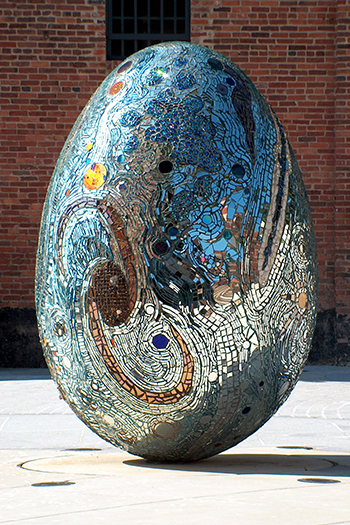
The sculpture Cosmic Galaxy Egg by Andrew Logan is located outside of the American Visionary Fine art Museum. Photo courtesy of American Visionary Art Museum
The museum curates and presents art in a format that transcends intergenerational barriers that oft plague traditional museums, hoping that everyone from five to 85 volition learn or see something they never have encountered prior to visiting AVAM. Primary among its educational goals is to "expand the definition of a worthwhile life."
The Visionary Art Museum is not about, "'Let me tell you why this is an important era in fine art,'" said Hoffberger. Instead, she said, "It's very oriented to wonder; what it is to be a human beingness, significant all the negative traits that human beings have long had and struggled with as well as their all-time characteristics."
The unadulterated testaments to joy, sadness, and humor hanging from the walls of the museum are non tempered past hyper-conceptual artistic trends popular within merely not necessarily outside of the art world. Annual exhibit themes range from this twelvemonth's Parenting: An Art without a Manual to previous exhibits similar Race, Grade & Gender: 3 things that contribute '0' to Grapheme, considering being a schmuck is an equal opportunity for everyone!
Although Hoffberger frequently has a hand in exhibition curation, at that place are no permanent curators on staff, allowing guest curators to contribute their own unique voice to the already unique museum. Visiting curators accept ranged from Simpsons creator Matt Groening to Ariana Huffington to Archbishop Desmond Tutu. Due to the relatively minor size of the upkeep, staff members frequently vesture many hats over the course of a year. At other museums, about large-scale temporary exhibits take years to plan, but according to Hoffberger, AVAM staff accept ever been "on fourth dimension and on upkeep" with their grand exhibitions, putting them together in roughly 9 months. This is fifty-fifty more impressive when yous consider that the majority of the administrative staff, like Hoffberger, has no traditional background in museum studies, although virtually accept feel in the arts.
While AVAM has significantly legitimized and raised the profile of visionary art in the U.s., its contributions to the local community of Baltimore are also meaning. "More urban museums present as fortresses proverb, 'Stay out, we have valuable things within,'" said Hoffberger. "Ours has always been a wonderland that you come upwards to at 3am and hug the Catholic Galaxy Egg outside and yous could walk on our property or you could skateboard here and be welcome to do so."
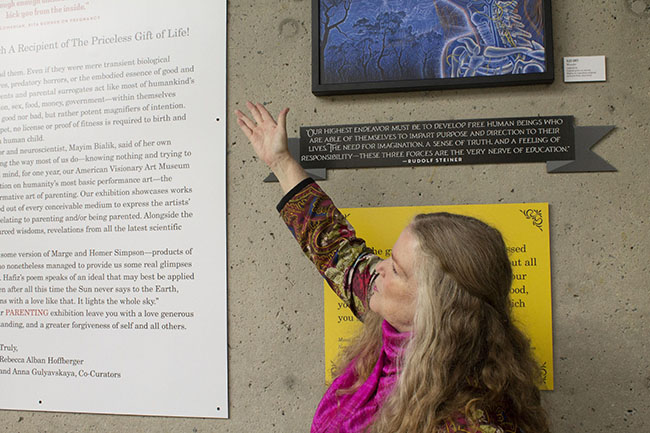
American Visionary Art Museum founder Rebecca Hoffberger at the entrance of the museum. Photo by Sophia Salganicoff
AVAM demonstrates this through an extensive delivery to education and grassroots community initiatives, including the famed Baltimore Kinetic Sculpture Race, its annual Martin Luther King, Jr. Solar day commemoration, apprenticeship programs, neighborhood movie nights, and more.
Social justice and grassroots educational activity inform nearly every facet of the museum, including the exhibition themes, customs outreach events, and fifty-fifty the mosaic adorning the main edifice. The mosaic, titled Shining Walls / Shining Youth is the outcome of the largest apprenticeship plan for incarcerated or at-risk youths in the state, according to the museum. It is dedicated to LeRoy Hoffberger, who passed away in 2013. The program "encourages teamwork, pride in creating something both exquisite and lasting, and results in real job skills, useful for the rest of their lives," according to the museum. This project, along with the museum's other community initiatives, has created a deep sense of respect and interchange between the Visionary Art Museum and the customs in which it exists.
Hoffberger recalls the dubiousness bandage in her direction during the beginning stages of AVAM, merely was willing to take the risk of following her intuition to nowadays those artists who had been marginalized by more conventional art museums. Though AVAM may lack the size and budget of other art museums, its impact cannot be denied.
Or equally Hoffberger quoted friend Dame Anita Roddick, "If you lot think you're too small to brand a difference, effort going to bed with a mosquito."
Sophia Salganicoff was an intern in the NEA Part of Public Affairs in fall 2018.
Source: https://www.arts.gov/stories/magazine/2018/3/pushing-boundaries-look-visionary-approaches-arts/not-your-average-art-museum
Belum ada Komentar untuk "American Visionary Art Museum American Visionary Art Museum Exhibits"
Posting Komentar